EU Stock · B2B only · 27 member states · FDCM E-Commerce S.A.
EN DE PL
📖 The Definitive Bulk Buyer’s Guide

Erythritol Bulk EU —
Everything You Need to Know
Before You Order

GI=0. Zero calories. E968 approved. ADI not specified by EFSA. This page covers the science, the safety data, the baking chemistry and the B2B pricing for erythritol in bulk from EU stock. If you’re sourcing erythritol for food production, this is where you start.

25 kg minimum order
EU stock DSV delivery
CoA per batch
E968 food grade
On this page
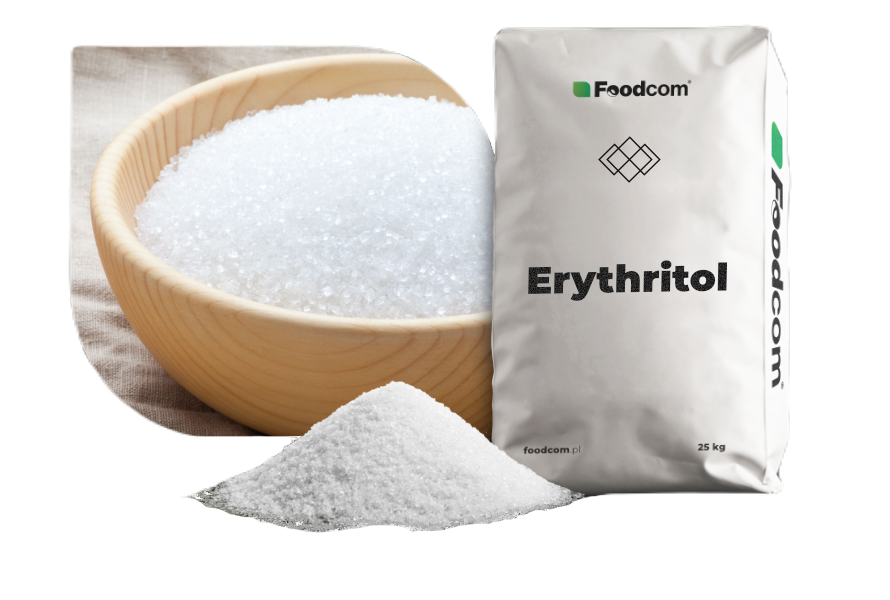
Erythritol BULK · E968 In stock
Erythritol bulk E968
€19.37 / 25 kg bag
from €19.37 per 25 kg · larger volumes on request
Purity≥99.5%
Glycaemic Index0
Calories0 kcal/g (EU)
E-numberE968
ADINot specified (EFSA)
Sweetness~70% of sugar
Packaging25 kg paper bag
DeliveryDSV · EU-27 · 3–7 days
Order on FDCM.eu → Questions? contact@fdcm.eu
0
Glycaemic Index
No blood glucose rise — EU health claim authorised (Reg. 1047/2012)
0 kcal
Calories per gram
Official EU designation under Regulation 1169/2011
70%
Sweetness vs sugar
Volume-for-volume substitute — no recipe restructuring needed
E968
EU food additive
Quantum satis — no quantity limit for most food categories
ADI (EFSA)
“Not specified” — no harmful threshold identified in any study
🦷
Non-cariogenic
Not fermented by oral bacteria — EU tooth mineralisation claim
The Science

What is erythritol — and why does it behave so differently?

Erythritol is a four-carbon sugar alcohol (polyol) with the molecular formula C&sub4;H&sub1;&sub0;O&sub4; and a molecular weight of 122.12 g/mol. It is naturally present in trace amounts in fermented foods (beer, wine, cheese), certain mushrooms and some fruits. Commercial erythritol, however, is produced via fermentative biotransformation of glucose using osmophilic yeasts — primarily Moniliella pollinis or Trigonopsis variabilis.

The production process begins with cereal starch (typically maize or wheat), which is enzymatically hydrolysed to glucose. The osmophilic yeast accumulates erythritol intracellularly as an osmotic protectant and secretes it into the fermentation medium. After fermentation, the broth undergoes filtration, ion exchange demineralisation, activated carbon decolourisation, evaporation and controlled crystallisation — yielding white crystalline powder at ≥99.5% purity.

The metabolic reason erythritol has 0 kcal and GI=0: Unlike other sugar alcohols, approximately 90% of ingested erythritol is absorbed in the small intestine. But here is the critical difference — it is not metabolised. No enzymatic cleavage occurs. It circulates in the bloodstream briefly and is then excreted renally, intact and unchanged. The 10% not absorbed in the small intestine reaches the colon but is largely not fermented there either, explaining the minimal laxative effect compared to xylitol or sorbitol.

This metabolic pathway is the reason the EU officially assigns erythritol 0 kcal/g under Regulation 1169/2011 — not a rounded approximation, but a genuine physiological zero. It is also why the glycaemic index is truly 0, not just low: erythritol does not interact with intestinal glucose transporters (SGLT1, GLUT2) and does not stimulate insulin secretion. The EU health claim confirming this is established in Regulation (EU) 1047/2012.

Structurally, erythritol forms monoclinic crystals with a melting point of 119–121°C and a solubility of approximately 37 g per 100 ml water at 20°C. It has a very low hygroscopicity — it does not readily absorb moisture from the air, unlike sorbitol or maltitol. Its heat of solution is strongly endothermic at approximately −40 J/g, which produces the characteristic cooling sensation when it dissolves on the tongue.

Production: from starch to crystal

1
Starch hydrolysis
Cereal starch is enzymatically broken down to glucose solution — the fermentation substrate.
2
Yeast fermentation
Moniliella pollinis ferments glucose to erythritol under controlled temperature, pH and osmolality.
3
Purification
Biomass filtration → ion exchange → activated carbon decolourisation → evaporation.
4
Crystallisation
Controlled cooling → monoclinic crystal formation → centrifugation → drying.
5
QC & packaging
Purity analysis, micro testing, CoA issuance → 25 kg paper bags.

Physical properties at a glance

Specification
Molecular formulaC₄H₁₀O₄
Molecular weight122.12 g/mol
Melting point119–121°C
Solubility (20°C)~37 g/100 ml
Crystal systemMonoclinic
HygroscopicityVery low
Heat of solution−40 J/g (endothermic)
Maillard reactionNone (not a reducing sugar)
Oral fermentabilityNon-fermentable
Direct Comparison

Erythritol vs sugar — the honest side-by-side

Erythritol is not a perfect sugar substitute in every context — but for specific applications it outperforms every alternative. Here is what the comparison actually looks like.

🍬 Sucrose (sugar)
Parameter
💠 Erythritol
4 kcal/g
Calories per gram
0 kcal/g
65
Glycaemic Index
0
100%
Sweetness
~70%
100 g
Volume in recipe
130 g (1.3×)
Yes
Maillard browning
None
Yes
Cariogenic (tooth decay)
No
No
Laxative effect
Low (>50 g)
Yes
Fermented by gut bacteria
Minimal
Yes
Hygroscopic
No
200 g/100 ml
Solubility (20°C)
37 g/100 ml
185°C
Melting point
119–121°C
None
EU health claims
2 authorised
No limit set
ADI
Not specified
~€3/kg
Wholesale price (EU)
~€19/kg
Key takeaway: Erythritol costs more per kg than sugar, but for keto, diabetic and calorie-reduced products it is the only bulk sweetener that simultaneously achieves GI=0 and 0 kcal while functioning at sugar-equivalent volumes. For these market segments, there is no direct substitute that does all three.
Full Market Overview

Erythritol vs all sweeteners — 12 options, 9 parameters

Every bulk sweetener option available in the EU market, compared on the parameters that actually matter for food formulation.

SweetenerE-No.Kcal/gSweetnessGI ADILaxativeCariesVolume use
ErythritolE9680~70%0Not spec.Low (>50g)NoYes (1.3×)
XylitolE9672.4~100%7–13Not spec.Medium (>20g)NoYes (1:1)
SorbitolE4202.6~60%4–9Not spec.High (>20g)LowYes (1.6×)
MaltitolE9652.1~90%36Not spec.MediumNoYes (1.1×)
IsomaltE9532.0~50%2–9Not spec.MediumNoYes (2×)
Sucrose (sugar)4100%65NoYesYes (1:1)
Glucose / dextrose4~75%100NoYesYes (1.3×)
SucraloseE9550600×015 mg/kgNoNoNo (ppm)
Acesulfame-KE9500200×015 mg/kgNoNoNo (ppm)
AspartameE9514200×040 mg/kgNoNoNo (ppm)
SteviosideE9600250–300×0Not spec.NoNoNo (ppm)
SaccharinE9540300×05 mg/kgNoNoNo (ppm)
Why erythritol stands out: It is the only sweetener in this table that combines GI=0 + 0 kcal/g + ADI not specified + volume-equivalent use (1.3:1 to sugar). High-intensity sweeteners (sucralose, stevia, saccharin) achieve GI=0 and 0 kcal but cannot replace sugar by volume — they provide no bulk, texture or Maillard precursors. Xylitol has a GI of 7–13 and 2.4 kcal/g. Maltitol has a GI of 36 — high enough to cause a measurable postprandial blood glucose response in diabetic consumers.
Regulatory Facts

Is erythritol safe? What the regulators actually say

Every regulatory claim on this page is referenced to its source document. No marketing language. These are the actual decisions from EFSA, the European Commission and the FDA.

EU Reg. 1333/2008

E968 — Approved Food Additive

Erythritol is authorised as food additive E968 across all EU member states under Regulation (EC) No. 1333/2008 on food additives. It is approved for a broad range of food categories — confectionery, bakery, beverages, dairy, dietary supplements — at quantum satis (no quantity restriction for most categories).

Status: Quantum satis — no upper limit
🧪
EFSA / JECFA 2000 & SCF 2003

ADI: Not Specified

The European Food Safety Authority and the JECFA (FAO/WHO) both assigned erythritol the status “ADI not specified” — meaning no acceptable daily intake limit could be determined because no harmful threshold was identified in any toxicological study. This is the highest safety classification an additive can receive. The only documented adverse effect is osmotic laxation at single doses above approximately 50 g.

ADI: Not specified (highest category)
📊
EU Reg. 1047/2012

Health Claim: GI=0

The European Commission authorised the health claim: “Erythritol does not raise blood glucose after consumption.” This is a substantiated claim under Article 13(1) of Regulation (EC) 1924/2006, established in Commission Regulation (EU) 1047/2012. It may be used on product labels without minimum quantity conditions.

Claim: Authorised — no minimum dose required
🦷
EU Reg. 1047/2012

Health Claim: Tooth Mineralisation

The second authorised health claim: “Consumption of erythritol-sweetened foods instead of sugar-sweetened foods contributes to the maintenance of tooth mineralisation.” Condition: erythritol must provide at least 10% of the total sweetening effect of the product. Clinical studies confirm erythritol actively inhibits the growth of Streptococcus mutans, the primary caries-causing bacterium.

Condition: ≥10% of sweetening effect from erythritol
🇺🇸
FDA 2001

GRAS Status (USA)

The United States FDA granted erythritol GRAS (Generally Recognised As Safe) status in 2001. Erythritol is approved for use in food in the USA, Japan, Canada, Australia, Brazil and all EU member states. No country with a modern food regulatory framework has restricted its use.

Status: GRAS — no restrictions in any major market
🔬
Clinical evidence

Metabolic neutrality confirmed

Multiple randomised controlled trials confirm erythritol’s metabolic neutrality in both healthy subjects and diabetic patients. A 2012 Cochrane-adjacent systematic review found no measurable effect on blood glucose, insulin, triglycerides or HbA1c. Studies in subjects with Type 2 diabetes show equivalent metabolic outcomes to water as the control — a result not achieved by any other polyol.

Evidence: No effect on glucose, insulin or HbA1c
Formulation Science

Erythritol in food production — the complete baking and formulation guide

Erythritol is the most widely used sugar substitute in keto and sugar-free food production — but it behaves differently from sucrose in ways that are critical to know before formulating. Understanding these differences prevents failed batches.

1. The 1.3:1 substitution ratio

Erythritol provides approximately 70% of sucrose’s sweetness. This means you need 130 g of erythritol to match the sweetness of 100 g of sugar. Critically, the volume and physical bulk remain nearly identical — unlike high-intensity sweeteners such as sucralose or stevia, which are used in parts per million and cannot replace sugar’s structural role in a recipe.

2. No Maillard reaction

Erythritol is not a reducing sugar. It does not participate in the Maillard reaction — the browning process responsible for the golden crust of baked goods. Products sweetened exclusively with erythritol will be significantly paler than their sugar-based equivalents. Workarounds: add a small amount of milk powder, WPC 80, egg yolk or a touch of honey/maple syrup as Maillard precursors. Alternatively, increase baking temperature by 10–15°C.

3. The cooling effect

Erythritol has a strongly negative heat of solution (−40 J/g). When it dissolves on the tongue, it absorbs heat, creating a cool, minty sensation similar to — but milder than — menthol. In mint chocolate, ice cream, chewing gum and cold beverages, this is a desirable quality that enhances freshness perception. In vanilla cream, warm custard and neutral pastry cream, it can be perceived as off. The solution: reduce erythritol content and supplement with stevioside or sucralose, which have no cooling effect.

4. Recrystallisation on cooling

This is the most common formulation problem with erythritol. When dissolved in water and cooled, erythritol recrystallises — producing a sandy, gritty texture in frostings, glazes, ganaches and no-bake products. The recrystallisation threshold depends on concentration and cooling rate. Prevention: limit erythritol to 60–70% of the total sweetener blend; add inulin (which inhibits crystal growth), glycerol (which acts as a crystallisation inhibitor) or a small percentage of sucralose/stevia. Keeping the product warm before serving also helps.

5. Melting and caramelisation

Erythritol melts at 119–121°C — well below sugar’s melting point of 185°C. It does not caramelise in the way sucrose does (no brown caramel compounds form). Instead, melted erythritol cools to a white, brittle mass. This makes it unsuitable for genuine caramel production. However, combined with a small amount of sweetened condensed milk or cream, acceptable keto caramel textures can be achieved via the Maillard reaction from the dairy components.
Application dosage reference

ApplicationDosageNotes
Keto chocolate80–100 g/100 g cocoa massCombine with 10–20% stevioside to reduce cooling effect
Keto cookies / biscuits130 g per 100 g sugar in recipeIncrease baking temp by 10°C for browning
Keto cakes & muffins130 g per 100 g sugarAdd 5% inulin to prevent crumbliness
Sugar-free beverages3–8 g/100 mlFully soluble cold; cooling effect enhances citrus/mint
Frosting / buttercreamMax 60% of sweetenerAdd glycerol or inulin to prevent crystallisation
Ice cream & frozen8–15 g/100 ml mixFreezing point depression lower than sucrose → firmer texture
Diabetic jam80–120 g/kg fruitCombine with pectin; monitor consistency
Chewing gum20–40% of gum base weightCooling effect is an advantage
Tablet / supplementAs neededChemically inert; no effect on active ingredients
Sugar-free hard candyNot recommendedRecrystallisation and brittleness are very pronounced
Pro tip: The most reliable erythritol blend for baking is 80% erythritol + 15% inulin + 5% stevioside. The inulin adds body and inhibits crystallisation; the stevioside compensates for erythritol’s 70% sweetness without adding calories or GI points.
Editorial Ranking

Best use cases for erythritol — ranked by suitability

Not every application is equally well-suited for erythritol. This ranking is based on how well erythritol’s specific properties match each application’s requirements — sweetness, bulk, texture, stability and cost-effectiveness.

# 1
🥇 Best fit

Keto & sugar-free chocolate

Erythritol is the undisputed standard for keto chocolate. It provides the bulk and sweetness of sugar at 1.3:1, it is compatible with cocoa butter and cocoa mass without causing fat bloom, and its mild cooling effect is masked by chocolate flavour. The combination of erythritol + 10–20% stevioside is now the industry standard for >70% of EU keto chocolate products. At 80–100 g per 100 g cocoa mass, the result is indistinguishable in sweetness profile from milk or dark chocolate.

Why it ranks here: Erythritol is uniquely suited here: volume substitute, cocoa-compatible, GI=0, clean label, no laxative risk at chocolate consumption levels. No other sweetener achieves all five simultaneously.
# 2
🥈 Excellent

Sugar-free & low-calorie beverages

In cold drinks — RTD teas, lemonades, sports drinks, flavoured waters — erythritol dissolves fully at typical concentrations (3–8 g/100 ml) and provides a clean sweetness without aftertaste. The cooling effect is an advantage in citrus and mint variants; neutral in others. GI=0 and 0 kcal enable “zero sugar, zero calorie” label claims.

Why it ranks here: Full solubility, clean taste profile, cooling synergy with citrus/mint, pH-stable across typical beverage pH range (2.8–6.5). Cost per dose is low due to small absolute volumes used.
# 3
🥈 Excellent

Diabetic & glycaemic-controlled foods

For foods targeting diabetic consumers, the GI=0 EU health claim makes erythritol the regulatory gold standard. Products can carry the authorised claim “does not raise blood glucose” — a claim no other polyol can make under EU law. Combined with the 0 kcal designation, erythritol enables true “diabetic-suitable” labelling.

Why it ranks here: The only sweetener with an EU-authorised GI=0 health claim (Reg. 1047/2012) and 0 kcal designation simultaneously. Regulatory compliance is built-in, not approximate.
# 4
🥉 Good

Keto bakery (cookies, cakes, muffins)

Works well in keto baking with correct technique. The 1.3:1 substitution is straightforward; volume and texture are close to the sucrose equivalent. The Maillard deficit is manageable with WPC 80 or egg yolk supplementation. Recrystallisation is not an issue in baked goods that are consumed warm or within 24 hours.

Why it ranks here: Strong volume match, good moisture retention, no laxative concern at typical serving sizes. The Maillard workaround adds formulation complexity but is well-established.
# 5
🥉 Good

Ice cream & frozen desserts

Erythritol lowers the freezing point less than sucrose (due to its molecular weight), producing a firmer frozen texture that holds well in transport. The cooling effect is desirable in frozen applications. It is stable through the pasteurisation step (72°C / 15 s) in ice cream mix production.

Why it ranks here: Heat stability, cooling effect advantage in frozen, lower freezing point depression. Works best in combination with inulin (body) and sucralose (sweetness intensity at low temperature, where sweetness perception drops).
# 6
🥉 Good

Supplement tablets & capsules

Erythritol is chemically inert — it does not react with vitamins, minerals, amino acids or botanical extracts. It acts as a carrier, binder and sweetener in chewable tablets and powder formulations. Its crystalline structure provides good compressibility in direct compression tablet manufacturing.

Why it ranks here: Chemical inertness, clean taste, good compressibility, GI=0 compliance for diabetic-suitable supplement claims. Standard in the EU supplement industry.
# 7
⚠️ Use with care

Buttercream & frosting

The recrystallisation problem is most severe in high-fat, cooled sugar systems like buttercream and Swiss meringue buttercream. Without crystallisation inhibitors, erythritol-based frostings become grainy within hours of refrigeration. Requires inulin, glycerol or a significant portion of high-intensity sweetener to remain smooth.

Why it ranks here: Possible but requires formulation work. Erythritol should not exceed 60% of sweetener content; glycerol and inulin addition is essential. Not recommended for first-time formulators.
# 8
❌ Not recommended

Hard candy & lollipops

Hard candy relies on boiling a sugar solution to specific temperatures (hard crack stage, 150–160°C) and cooling to a glassy, amorphous state. Erythritol does not produce a stable glassy state — it recrystallises rapidly and produces a brittle, white, opaque mass that shatters rather than forming a clear candy.

Why it ranks here: The recrystallisation tendency is fundamentally incompatible with hard candy production. Isomalt is the correct polyol for this application.
B2B Market Segments

Who buys erythritol in bulk — and what they use it for

Erythritol bulk buyers span multiple industries. The common thread is the need for a high-volume sugar substitute with clean regulatory status and reliable EU supply.

🍫

Keto & Low-Carb Brands

The largest and fastest-growing segment. Keto chocolate, cookies, protein bars and meal replacement products all use erythritol as the primary bulk sweetener. EU keto market was valued at €1.2B in 2024 and growing 18% YoY.

Typical order: 200–2,000 kg/month
📊

Diabetic Food Manufacturers

Food companies producing products for diabetic consumers require the EU-authorised GI=0 health claim. Erythritol is often the only sweetener that meets both the regulatory requirements and the volume/texture needs of these products.

Typical order: 500–5,000 kg/month
💪

Sports & Nutrition Brands

Protein bars, pre-workout supplements, recovery drinks and chewable tablets. Erythritol provides sweetness without affecting insulin response — critical for peri-workout nutrition products where insulin management matters.

Typical order: 100–1,000 kg/month
🧁

Confectionery Manufacturers

Sugar-free confectionery: gum, mints, hard-boiled sweets (with isomalt as carrier), chocolate-covered products. Erythritol used as part of blend, often with maltitol or isomalt for texture.

Typical order: 1,000–10,000 kg/month
🧫

Beverage Producers

RTD teas, flavoured waters, soft drinks, energy drinks and functional beverages targeting zero-sugar positioning. Erythritol provides body and mouthfeel that high-intensity sweeteners cannot match.

Typical order: 200–2,000 kg/month
💊

Pharmaceutical & Supplement

Tablet manufacturers, capsule fillers, chewable supplement producers. Erythritol used as carrier, binder and sweetener. Regulatory neutrality and chemical inertness are key requirements.

Typical order: 50–500 kg/month
FAQ

Frequently asked questions about erythritol

Both are sugar alcohols (polyols), but they differ critically: erythritol has 4 carbons, xylitol has 5. Erythritol provides 0 kcal/g (EU official), xylitol provides 2.4 kcal/g. Erythritol has GI=0, xylitol has GI of 7–13. Most importantly, erythritol is absorbed in the small intestine and excreted unchanged — it is not metabolised at all. Xylitol is partially fermented in the colon. This explains why erythritol has a much lower laxative effect (threshold ~50 g per dose) versus xylitol (~20 g). Both are non-cariogenic, but xylitol has stronger documented anti-caries activity. For keto and diabetic applications, erythritol is strongly preferred. For dental products, xylitol is often chosen.
The EFSA Scientific Committee on Food (SCF, 2003) and JECFA (2000) assign “ADI not specified” when exhaustive toxicological studies — including long-term animal studies, genotoxicity tests and human clinical trials — fail to identify any dose at which an adverse effect occurs. For erythritol, no carcinogenicity, genotoxicity, reproductive toxicity or organ-specific toxicity was found at any tested dose. The only documented adverse effect is osmotic diarrhoea at single doses above approximately 50 g in adults — a dose equivalent to eating 200 g of keto chocolate in one sitting. This is a mechanical effect, not a toxicological one.
Use 130 g of erythritol for every 100 g of sugar called for in the recipe (1.3:1 ratio). Volume and weight in the batter or dough will be approximately the same. Key adjustments: (1) Add a Maillard browning agent if needed (egg yolk, milk powder, WPC 80) since erythritol does not brown. (2) For frostings, add inulin or glycerol to prevent graininess. (3) In chocolate, combine with 10–20% stevioside to reduce the mild cooling effect. (4) Increase oven temperature by 10–15°C for golden products.
Yes — erythritol is considered the safest sugar substitute for people with diabetes and is widely used in diabetic food products. The EU has authorised the health claim “erythritol does not raise blood glucose after consumption” under Regulation (EU) 1047/2012, based on clinical evidence. Multiple randomised controlled trials have confirmed this in both Type 1 and Type 2 diabetic patients. Unlike maltitol (GI=36) or sorbitol (GI=4–9), erythritol has a confirmed, measured GI of zero. It also does not stimulate insulin secretion. Persons with diabetes should still manage total carbohydrate intake, but erythritol itself requires no insulin or blood glucose management.
At normal food consumption levels, no. The laxative threshold for erythritol in most adults is approximately 50 g per single sitting — considerably higher than xylitol (~20 g) or sorbitol (~20 g). In typical food products, a serving would contain 5–20 g of erythritol at most. Individual sensitivity varies, and some people may experience mild discomfort at lower doses. Children have lower thresholds. EFSA’s “ADI not specified” classification confirms no systemic safety concern — the only relevant effect is the mechanical osmotic laxation at high single doses.
Erythritol is produced through fermentation, which is a more complex and capital-intensive process than sugar extraction from sugar beet or cane. The fermentation step, followed by purification, crystallisation and drying, requires significant equipment and process control. Production costs are also affected by glucose substrate price (linked to cereal commodity markets). At EU wholesale prices around €19/kg (25 kg bags), erythritol is approximately 6× the cost of sugar per kg — but in food products, the higher cost per kg is offset by the GI=0 and 0 kcal positioning, which commands significant premium pricing in the keto and diabetic food segments.
Erythritol can be used in clean-label products — it is declared as “erythritol” on ingredient lists (not as E968, though that is also permissible) and is recognised as a natural-origin ingredient since it occurs naturally in fermented foods. However, erythritol is not approved for certified organic food products under EU organic regulations (Regulation (EU) 2018/848), as it is produced by industrial fermentation rather than extraction from organic sources. For organic products, pure stevia or concentrated fruit juice are the compliant options.
Standard documentation included with every order: Certificate of Analysis (CoA) per batch — purity, moisture, pH, heavy metals, TPC, coliforms, Salmonella, Listeria. Available on request at no charge: Technical Data Sheet (TDS), allergen declaration, non-GMO statement, EU Regulation 1333/2008 compliance statement, FSSC 22000 / BRC supply chain certificate, country of origin. All documentation in English; German and Polish translations available on request.
Minimum order is 25 kg (one paper bag). No framework contract or annual volume commitment required. For in-stock products, order processing is 1–2 business days. EU delivery via DSV road freight is 3–7 business days to all 27 EU member states. Larger volumes (pallets, full truck loads) are available with longer lead times if not in stock — contact FDCM directly for quotation.
Store in a cool, dry place at temperatures below 25°C, away from direct sunlight and moisture. Erythritol’s low hygroscopicity means it absorbs very little atmospheric moisture — significantly less than sucrose or xylitol — making storage relatively straightforward. Keep bags sealed when not in use. Shelf life is 24 months from production date in original sealed packaging. Avoid storage near strong-smelling substances as erythritol can absorb trace odours.
Order & Enquiries

Buy erythritol bulk from EU stock

We respond to all B2B inquiries within 4 business hours

Operated by

FDCM E-COMMERCE SPOLKA AKCYJNA
Krzysztofa Komedy 2/3
02-517 Warszawa, Poland
VAT: PL5214100463

Contact

contact@fdcm.eu

fdcm.eu — full catalogue & online ordering

EU Delivery

DSV road freight · 3–7 business days
All 27 EU member states
View delivery options →

Ready to order erythritol from EU stock?

From 25 kg, live pricing, CoA per batch, DSV delivery to all 27 EU member states. No framework contract required.